
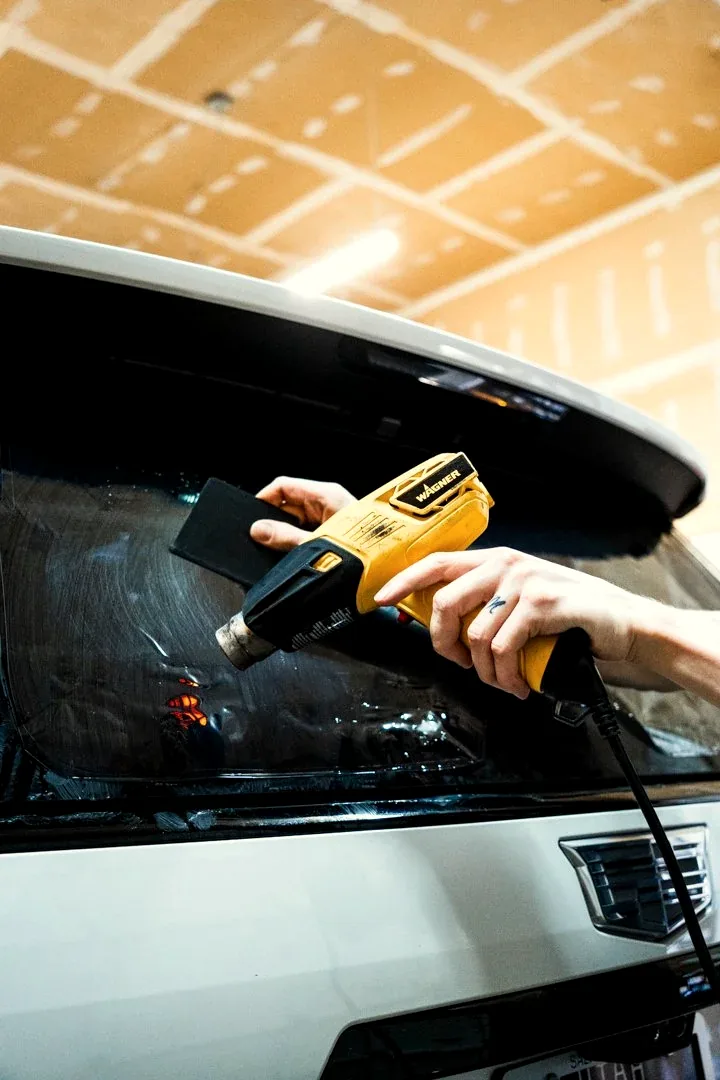
Purple, bubbled, gone.
Old film stripped, the glue underneath cleaned off properly, and the defroster lines on your back glass left doing their job. Then, if you want, new film with a lifetime warranty on top.
Cheap film always tells on itself.
Dyed film is colour held in a layer of plastic. Park it in Utah sun for a few summers and the dye gives out, starting with the blues. What's left is that unmistakable purple, and by then the glue underneath has usually started breaking down too.
Those bubbles aren't air getting in from outside. They're the adhesive letting go of the glass in patches, which is also what the cloudy haze and the crinkled edges are. It doesn't get better, it doesn't buff out, and no amount of cleaner touches it, because the problem is between the film and the window.
- Purple film — the dye has faded out and won't come back
- Bubbles and blisters — the adhesive has released from the glass
- Milky or hazy patches — same failure, caught earlier
- Peeling corners and creased edges, usually where a blade once was
- Scratched, sandpapered-looking film from years of window switches
Every film we install carries a lifetime XPEL warranty against precisely this — bubbling, peeling, cracking, fading and purpling. It's the whole reason to buy film once instead of three times.
Slow is the trick.
There's no clever machine for this part. Removal is heat, steam, patience and knowing when to stop pulling. The whole job is judged on what the glass looks like when the old film is off.
Interior covered
Door cards, speakers, seats and the parcel shelf get covered before anything gets wet, because removal makes a mess and your headliner shouldn't wear it.
Film softened
Heat and steam go in first to soften the old adhesive so the film releases instead of tearing into confetti. Rushing here is what turns an afternoon into two.
Film pulled
Lifted slowly and at a low angle so it comes away in sheets where it can. On the back glass it's pulled along the defroster lines, never across them.
Adhesive cleaned off
The glue left behind is the real work. It gets softened and lifted off the glass completely — not smeared around, not left as a haze you only notice at night.
Glass checked
Cleaned, dried and looked at in the light from both sides. If new film is going on, it goes on glass that's genuinely clean, because anything left behind is sealed under there for good.
No blades and no razors on your glass at any point — not on the way off, not on the way back on.
Everything rides on the back glass.
Door windows are straightforward. The back window is where removals go wrong, and it's the piece that decides how long your car is with us.
Three things stack up back there. It's one big pane curved in two directions, so the film doesn't want to come off evenly. It's the window that gets the most direct sun, so the film there is usually the most baked-on in the car. And the defroster grid is printed right onto the inside surface of the glass, sitting under the film you're trying to remove.
- Those lines are on the surface, not inside the glass — scrape and they're gone
- A broken line means a stripe of your back window that never clears in winter
- Pulling across the grid instead of along it is the most common way it happens
- Steam and heat lift the film; a razor takes the grid with it
- We pull along the lines, at a low angle, and we take the time it takes
If a previous shop already broke a line, we'll tell you when we see it rather than let you find out in November. Same goes for chips, scratches or a cracked window hiding under old film — you'll hear about it before we go further.
Priced on how bad it is.
We don't publish a removal price, because there isn't an honest one. Film that releases in sheets is a different afternoon from film that's been cooking on a back window since the last owner put it there.
How many windows, how old the film is, how it was installed, and what the glue has done to the glass. Text a few photos — one of the back window and one of a door — and we'll get close before you drive over.
Putting new film on straight after? Ask for both on one quote — removal and re-tint in the same visit is cheaper and easier than two trips.
New film starts at $279 for a full car in Color Stable. The ceramic options are on the ceramic tint page, and the full price book is on the automotive tint page. While the car's here, paint protection film and ceramic coating can go on the same quote.
Before you book.
What does removal cost?
Why did my tint go purple?
Will it wreck my defroster lines?
Can you remove and re-tint the same day?
Do I have to put new film back on?
Live generously.
Old film off, clean glass back, defroster lines intact. Bring it by 5804 Harrison Blvd and we’ll take a look.
Talk to Landon.
Tell us the year, make and model and you'll get a real number back, usually the same day. Calls and texts are fastest.